Why the pines are still dying three summers after Ian
Slash pine is the native tree of the Cape and the worst survivor of a hurricane. Here's what Ian did to them, why they take years to show it, how to read a dying pine, and which ones need to come down now.
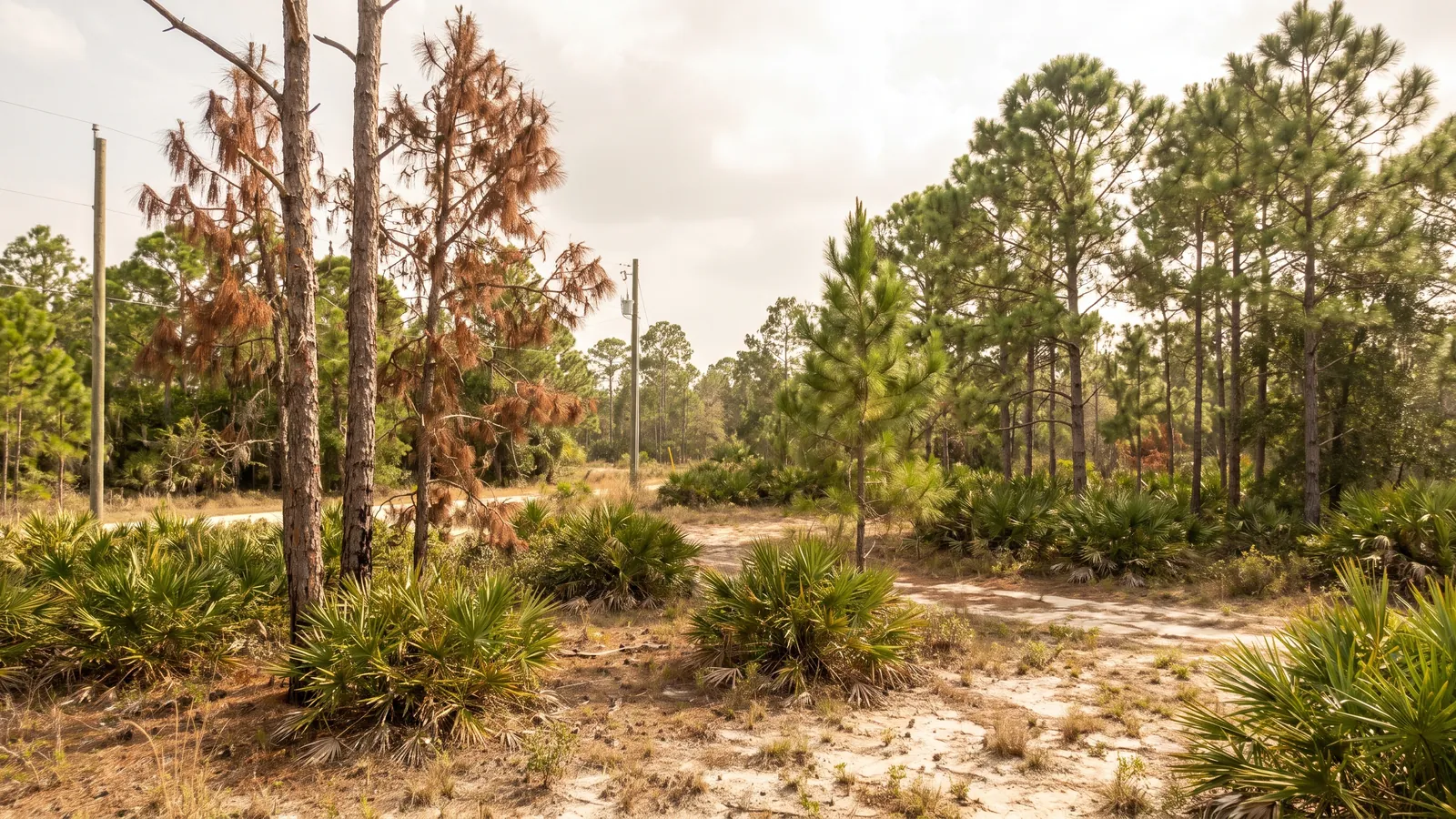
What the storm did
On September 28, 2022, Ian's eyewall put 140-mph gusts across the south Cape and well over 100 everywhere in the city, and it did it over hours, with the ground saturated by the rain bands that came first. Slash pines have a shallow, spreading root plate in Cape Coral's sandy fill. Hours of rocking in wet ground tears the fine roots, lifts one side of the plate, and cracks the wood inside the trunk along the growth rings — a defect called ring shake that you can't see from outside. In the south Cape the surge added saltwater: six to nine feet of it up the canals, soaking the root zones of every pine from the seawall back to the house.
Why it takes years to show
A rocked pine doesn't die in the storm. It looks green through the winter, because the damaged roots can keep up with the tree's needs in the cool months. The following summer the heat and the growth demand outrun what the roots can deliver, the needles go yellow, then red-brown from the top or the tips down, and the tree is dead by fall. The pines that had a little more root left survived 2023 and failed in 2024; the ones with a little more are failing now. University of Florida's post-hurricane guidance says plainly that pines "start to look like they are dying the summer following the hurricane," and that there's no treatment.
The beetles
Ips engraver beetles are always present in the pine flatwoods at low numbers, breeding in broken limbs and dying trees. After a hurricane there are thousands of stressed pines and the populations explode. The beetles bore into the bark of a weakened pine — look for popcorn-sized blobs of pitch on the trunk, called pitch tubes, and reddish-brown boring dust in the bark crevices and at the base — and the galleries they cut under the bark girdle the tree. A pine that might have limped through on damaged roots dies in weeks once the beetles find it. Spraying doesn't help a tree that's already attacked, and preventive spraying of every pine on a lot isn't practical; the real control is removing dead and dying pines promptly so the beetles don't breed in them and move to the next.
How to read a pine
- Green needles, no pitch tubes: alive. Watch it through the summer; water it through drought if it's a tree you care about.
- Green needles, pitch tubes on the trunk: under attack. Usually a removal within the season, before the beetles emerge.
- Yellow to red-brown needles: dead or dying; it will not recover. This is the cheapest and safest time to remove it — the wood is still sound to climb and rig.
- Gray needles, bare twigs: dead six months or more. The small limbs are dropping and the top is brittle. Remove soon, and expect the crew to work it more carefully.
- Bark sloughing, fungus on the trunk, mushrooms at the base: the root plate is rotting. The tree can go over in a thunderstorm. Over anything it could hit, it comes down now, often by crane because it's too brittle to climb.
Which pines to remove, and when
Any pine with red or gray needles that could reach a house, a pool cage, a driveway, a dock or a power drop — and on an 80-by-125 lot, that's most of them. Red needles are the moment: sound wood, no surprises, a normal price. Several dead pines on one lot come out at a lower per-tree price in one visit, which is why Lehigh and North Cape owners usually call about three or four at a time. A dead pine on a big lot away from everything can stay as a wildlife snag if you like; the woodpeckers and the owls will use it.
What to do for the survivors
Pines in a group protect each other, so removing the dead ones exposes the rest to wind — our arborist checks the lean, crown density and root flare of the survivors before we take down their neighbors. Don't fertilize a stressed pine (it feeds the beetles' preferred food), do water it through the dry spring, don't trench or pave within the root zone, and watch the trunk for pitch tubes every spring for the next few years.
Common questions
My pine looked fine until this July. Is it really Ian?
Almost certainly. Three summers of delayed decline is exactly what the research predicts after a storm of Ian's size, and the south Cape's salt exposure added a second cause. Pines that go red in a single summer with no beetle signs are usually root failure from the storm.
Can I save it with water or fertilizer?
Once the needles are red, no. A green pine with a lifted root plate can sometimes be kept alive with careful watering through the dry season — and left alone otherwise — but it's a tree to watch, not to trust over the house.
Will the beetles spread to my neighbor's pines?
That's the risk, and the reason to remove a beetle-hit pine promptly. We chip and haul infested wood the same day; leaving it stacked on the lot lets the brood emerge.
What does a dead-pine removal cost?
$500–$1,200 on an open lot, $1,200–$2,500 over a structure, $2,500–$5,000 by crane on a tight canal lot, and $400–$1,500 each when several come out in one visit. Stumps $150–$400.
Related: Dead pine removal · Crane removal · Hurricane prep guide · Lehigh Acres