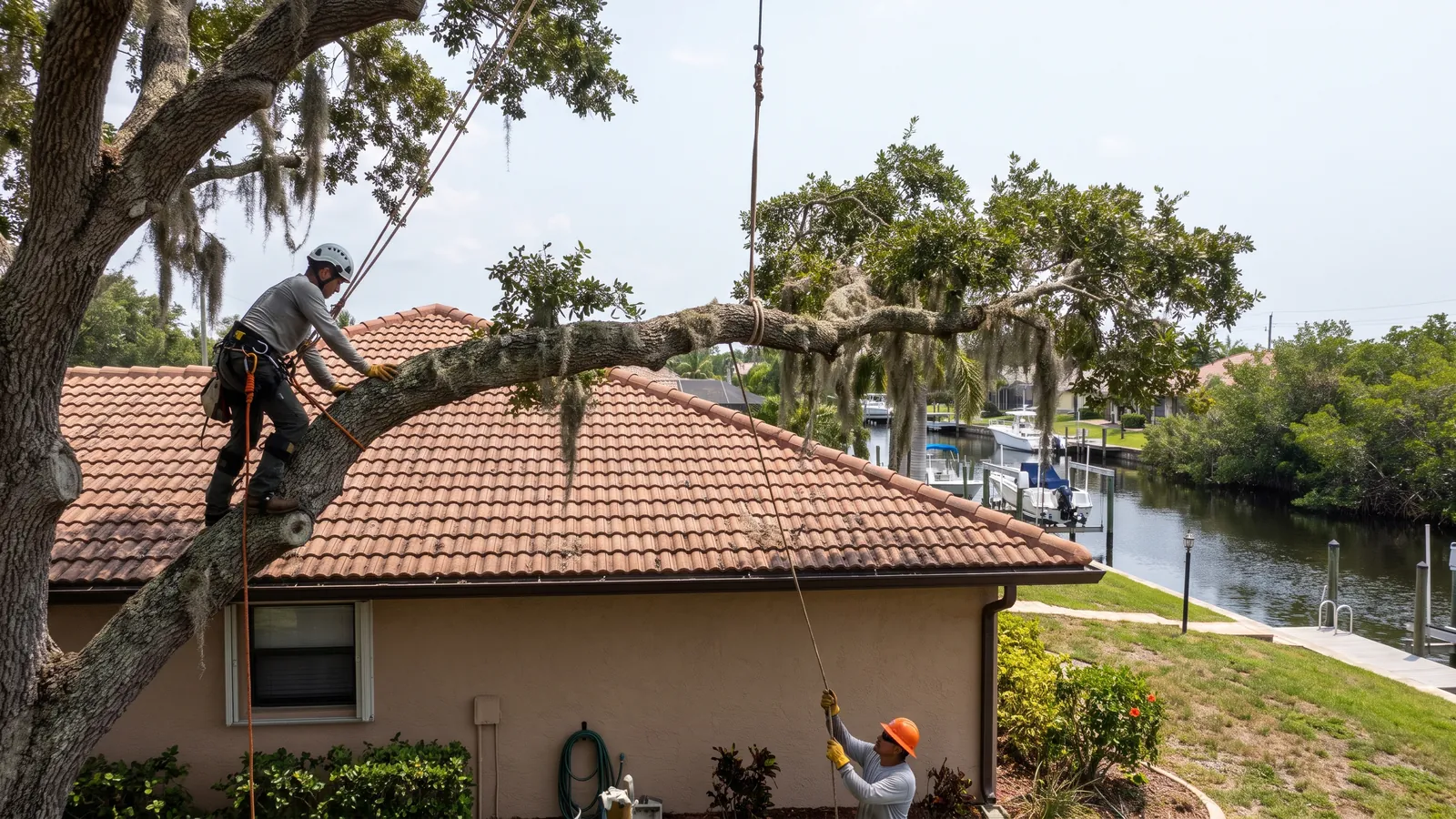
Three things set the price of a tree removal in Cape Coral: how big the tree is, what's underneath it, and whether a crane has to do the lifting. On a standard 80-by-125 lot the second and third are usually the story — the tree is between a house, a pool cage, a seawall and a neighbor, and the price is for getting it down in pieces without touching any of them. Here are the 2026 ranges we use, drawn from our own jobs and checked against the published Lee County averages (which put the typical Cape Coral removal at $566 to $737 and emergency work at about $845).
By size
| Tree | Typical 2026 price | Examples |
|---|---|---|
| Small, under 25 ft | $200 – $500 | Crape myrtle, young oak, seagrape, small palm |
| Medium, 25–50 ft | $500 – $1,200 | Ficus, black olive, mahogany, mid-size slash pine, Norfolk |
| Large, 50–75 ft | $1,200 – $2,500 | Mature slash pine, big live oak, Australian pine |
| Very large, 75 ft and up | $2,000 – $4,000 | The biggest pines and Australian pines; usually crane |
| Palms | $150 – $1,200 | Queen or foxtail at the low end, 70-ft royal or coconut at the top |
| Crane removal | $2,500 – $7,000 | No drop zone; lifted over the roof to the street |
| Stump grinding | $150 – $500 | $3–$5 per inch of diameter, $150 minimum |
| Emergency / after hours | + $400 – $1,500 | Tree on a structure, blocking a road, on a service drop |
What makes a Cape Coral removal cost more
The canal lot
A tree on a Gulf-access lot in the southwest or southeast Cape is almost never felled whole. The house, the cage, the seawall cap, the boat lift and the neighbor's dock are all inside the canopy, so every limb and trunk section is roped down by a ground crew. That's a full day for a four-person crew on a big tree, versus a morning for the same tree on an open North Cape lot. Nothing is dragged across the seawall cap and nothing goes in the water, and that care is in the price.
The crane
When there's no landing zone at all — a seventy-foot pine between the house and the water — a crane lifts the sections over the roof. Crane time is $250–$600 an hour with a four-hour minimum, but a crane job often costs less than two days of rigging, and it's safer for the house. See crane removal.
Species
Australian pines are tall, brittle and shallow-rooted, with a long trunk that has to be sectioned over the water on canal lots: $800–$3,500 each. Royal palms weigh several tons and come down in heavy trunk sections: $500–$1,200. Ficus and black olives are wide and heavy-limbed. Pines are tall but light to rig. A palm killed by Ganoderma costs an extra $150–$400 because the lower trunk and stump are dug and landfilled rather than chipped and ground.
Access and haul-off
Cape Coral's curbside horticulture pickup won't collect stumps, logs, root balls or anything a tree company cut, so hauling is part of every job. A lot with gate access for the chipper and a place to stage the truck is cheaper than one where everything is carried out by hand.
Timing
Off-season (November to May) and scheduled is cheapest. Storm week is most expensive: emergency crews, overtime and a queue. The same Australian pine that costs $1,800 to remove in March costs $3,500 to get off a roof in October.
What makes it cost less
Several trees in one visit share the setup — a row of dead pines on a Lehigh lot or three Australian pines along a canal come out at a lower per-tree price. Keeping the wood (oak and mahogany rounds, chips for mulch) takes money off the haul. An open drop zone you're willing to let us use — a strip of lawn we can lower to — can turn a crane job into a rigging job. And neighbors scheduling together get the crane for a day at a better rate than one lot at a time.
What you don't pay for in Cape Coral
A city permit. Cape Coral requires none to remove a tree on a residential lot, and F.S. 163.045 bars any fee or replanting for an arborist-documented risk tree. Fort Myers, the islands and some county parcels do have permit fees, and we include them in the written price where they apply. The free things on every job: the estimate, the arborist's opinion on whether the tree needs to go, and the burrow and mangrove check.
Common questions
How accurate is a phone or photo price?
Within a range. A photo from the street tells us the species and roughly the height; it doesn't show the drop zone, the root flare, the pool cage behind the house or the seawall. The estimator's visit turns the range into one number, in writing, good for 30 days.
Why did two companies quote such different prices?
Usually one of them is planning to fell or drop the tree and the other is planning to rig it in sections. On a canal lot the cheap quote is the dangerous one. Ask each how the tree is coming down and whether they carry workers' comp — the uninsured crew is always cheaper until something breaks.
Is removal cheaper than pruning in the long run?
For an Australian pine or a dead pine, yes. For a healthy live oak, black olive or mahogany, no — a thinning every three to five years is far cheaper than a removal, a new tree and twenty years of waiting for shade.
Do you charge to look?
No. Estimates are free. A formal written risk assessment or an F.S. 163.045 letter is a small flat fee, credited toward the work.
Related: Tree removal · Crane removal · Stump grinding · Do you need a permit?